Dynamic Resource Scheduler
Whats New!
User Experience Changes
Security and Authentication
Modules and Utilities
Cyclical Scheduling - Configuration Interface
Cyclical Scheduling - Now Bulk Scheduling
Resource Quotas Improvements - Percentages
Architecture and Scheduling
Configuration
User Guides and Help
Get to Know Dynamic Resource Scheduler
How Does Dynamic Resource Scheduling Work
Speaking the Language of Scheduling
Navigating Dynamic Resource Scheduler
How your Data Links Together
Managing your Organisation
Viewing your Data
Your Customer Data
Your Service Orders
Your Jobs
Your Workers and Resources
Manage Your Tasks
Actioning your Jobs and Tasks
Job Templates
Find A Jobs Possible Workers
Locking Your Jobs
Create a Follow On Task
User Queues and Organising Your Tasks
Schedule and Organise
How to Optimise Your Scheduling
How to Schedule Manually
Scheduling Mutliple Jobs at Once
Reassign and Reschedule your Tasks
Managing Your Time and Durations
Managing your Comments and Contacts
Using Bookmarks to Drive Efficiency
Managing Your Job Status
Visualising Your Planning
Workers and Resources
Advanced Data Management
Creating Unavailability in your Workforce
Adding an Unavailability to an Individual Worker
Creating Unavailabilities for Multiple Days or Workers
Maps And Journey
Using Maps to Visualise Your Data
Using Maps With Your Data
Learn about our Closest Function
Your Journeys
Meetings and Non-Productive Planning
Administer Your Scheduler
Managing Your Organisations and Agencies
Managing Your Custom Data
Managing your Contracts
Customising Your Experience
Managing Depots and Starting Locations
Managing Diary Bookmarks
Managing your External Chart Views
KPI Settings
Managing Your Priorities
Learn about Sectors
Managing Your Follow On Templates
Get To Know Your Working Time Calendar
Managing your SOR Templates
Managing your Job Templates
Managing Your Vocabulary
Managing Your Bookmarks
Manage Your Customer Templates
Get to Know Import and Export
Managing Your Tenant Code Rules
Managing your Order Templates
Managing Your Unavailability Reasons
Get To Know Your Working Time Calendars
Managing your Worker Templates
Releases and Readiness
DRS 6, DRS 5.7 and Job Manager
User Guides and Help
Get to Know DRS
Dynamic Scheduling - How does it work
Navigating DRS
Vocabulary and Concepts
Customers
Orders
Jobs
Scheduling Jobs
Job Functions
Workers
Views
Object Inheritance
Agencies
DRS Modules
Scenario Based Planning
Managing your SMS Service
5.7 Documentation
Technical Documentation
Release Notes
DRS 6.1 Release Notes
DRS 6.1.22 - February 20, 2026
DRS 6.1.21 - September 10, 2025
DRS 6.1.20 - April 20th, 2025
DRS 6.1.19 - 11th April, 2025
DRS 6.1.18 - 13 February 2025
DRS 6.1.17 - 20th December 2024
DRS 6.1.16 - November 8th, 2024
DRS 6.1.15 - October 10th, 2024
DRS 6.1.14 - 6th September 2024
DRS 6.1.13 - 9th August 2024
DRS 6.1.12 Release Notes
DRS 6.1.11 Release Notes
DRS 6.1.10 Release Notes
DRS 6.1.9 Release Notes
DRS 6.1.8 Release Notes
DRS 6.1.7 Release Notes
DRS 6.1.6 Release Notes
DRS 6.1.5 Release Notes
DRS 6.1.4 Release Notes
DRS 6.1.3 Release Notes
DRS 6.1.2 Release Notes
DRS 6.1.1 Release Notes
DRS 6.1.0 Release Notes
DRS 6.0 Release Notes
DRS 6.0.0.0 Release Notes
DRS 6.0.0.1 Release Notes
DRS 6.0.0.2 Release Notes
DRS 6.0.0.3 Release Notes
DRS 6.0.0.4 Release Notes
DRS 6.0.0.6 Release Notes
DRS 6.0.1.0 Release Notes
DRS 6.0.1.1 Release Notes
DRS 6.0.1.2 Release Notes
DRS 6.0.1.3 Release Notes
DRS 6.0.1.4 Release Notes
DRS 6.0.1.5 Release Notes
Kirona Housing
Job Manager 9
Job Manager 9.3.0 - October 2024
Job Manager 9.1.0 - December 2022
Job Manager 9.2.0 - November 2023
Release Notes Disclaimer
Administering your Field Service Products
Supported Versions Policies
Contents
- All categories
- Dynamic Resource Scheduler
- User Guides and Help
- Administer Your Scheduler
- Managing Your Follow On Templates
Managing Your Follow On Templates

Follow-on Templates allow you to control what appears on the Create Follow On screen and how much flexibility users have when raising follow-on jobs. By amending the Default Follow-on Template or creating your own, you can choose which fields are available, populated, hidden, mandatory, editable, or inherited from the parent job or underlying Business Data. Additional follow-on templates can also be created, although these are only available for use through the Create Follow On Service.
How to use Follow-on Templates
Follow-on Templates can be assigned to Job Templates, Intelligent Services, Customers and Orders. By configuring the key information required for different delivery scenarios, you can help users create follow-on jobs more quickly and consistently, with actions better aligned to the required outcome.
Configuring your Follow On Templates
When creating a new follow-on job template, the header defines the core rules for how the follow-on behaves. This includes setting a unique template name, deciding whether follow-ons can be created from completed orders, whether users can change the duration or job template, how the new job duration should be calculated, and which job statuses are allowed to trigger a follow-on.
Clicking the Add button will present the following screen to create a new follow-on job template
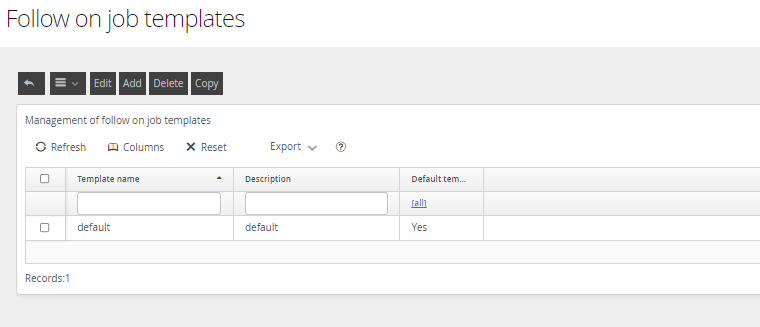
Once the template header has been saved, you can configure the Business Data attributes that appear during follow-on creation. Each attribute can be positioned, hidden, made read-only, made editable, or marked as mandatory. Default values can also be inherited, copied from the parent job, or manually customised, including limiting and selecting values from closed lists where applicable.

Field Name | Details |
Name | This is a mandatory field and cannot be left blank and it requires a unique Name. |
Allow on Completed Order | Allow the follow on to apply to a fully completed order or not. |
Allow Duration Change | Allow the user creating the follow on to change the duration of the follow-on job. |
Allow Job Template Changes | Allow the user creating the follow on to change the Job Template of the follow-on job. |
Calculation New Job Duration | Allows the follow-on job duration to be calculated from one of the following factors:
|
Job Status Allowed | Allows the selection of Job Status’s configured in Business Data of which the follow on can be created from 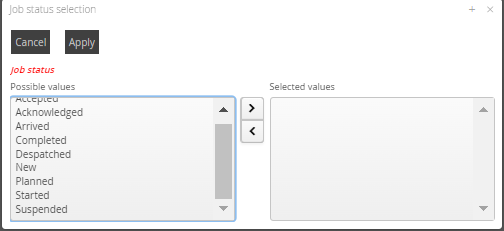 |
Once the above information has been saved the Business Data which can be viewed and amended on the follow-on creation screen can then be configured.
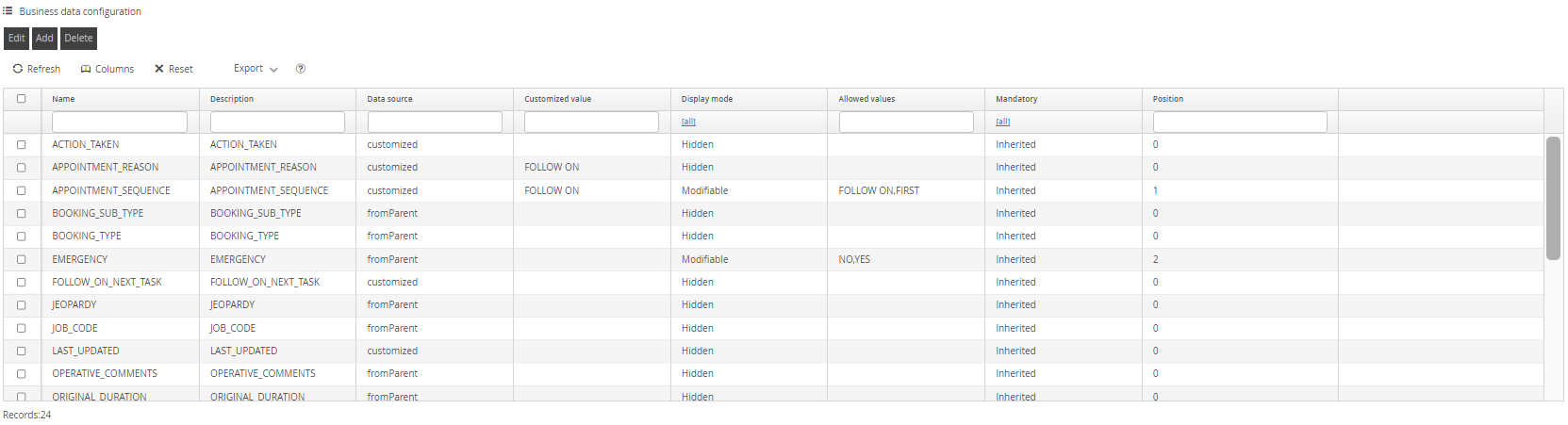
Clicking Add will present the following to allow the Attribute to be selected which can be customized
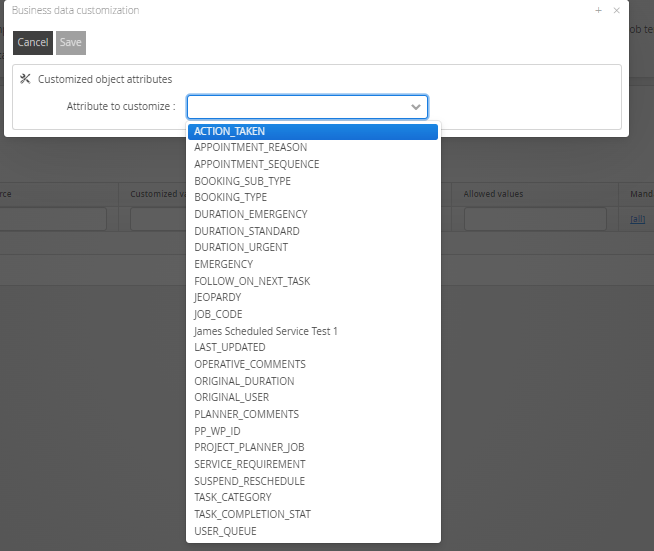
Selecting the attribute will display a window like below:
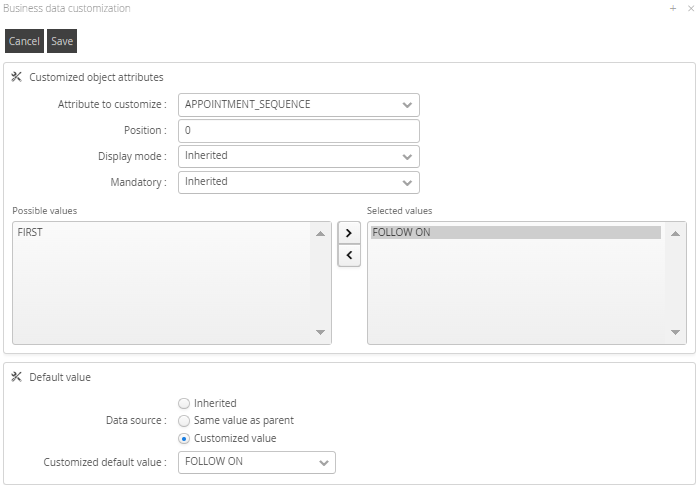
Within this window, the following information can be configured:
Field Name | Description |
Attribute to customize | This is the attribute, which was selected initially, however this can be changed if required using the drop down. |
Position | This denotes the order position of the attribute when displayed |
Display Mode | Options for this include: Inherited - inherit the display mode from the Business Data display mode Hidden - Hide the attribute (usually used within conjunction with a default value – see below) Not modifiable - Does not allow the value to be modified (usually used within conjunction with a default value – see below) Modifiable - Allows for the value to be changed. |
Inherited | Options for this include: Inherited – inherit the Mandatory settings from the Business Data Mandatory settings Yes – The value must be populated before the follow on can be created No – the value does not need to be populated if not required |
Possible Values (only visible on a closed list) | This list is populated from the values specified in the closed list within the Business Data section. |
Selected Values (only visible on a closed list) | These are the values which are selected from the Possible Values section to the left of it. Using the arrows will populate/unpopulated this list. |
Default Value | Inherited - inherit the default value from the Business Data Same Value as Parent – uses the same default value as the parent job Customized Default Value– Once the Selected Values section is populated this dropdown will be able to select a default value for the attribute from this list. If it is not a closed list, then this will be a free text option. |
Once Completed, clicking the Save button will add the Custom Object Attribute to the Follow-on Job Template