Dynamic Resource Scheduler
Whats New!
User Experience Changes
Security and Authentication
Modules and Utilities
Cyclical Scheduling - Configuration Interface
Cyclical Scheduling - Now Bulk Scheduling
Resource Quotas Improvements - Percentages
Architecture and Scheduling
Configuration
User Guides and Help
Get to Know Dynamic Resource Scheduler
How Does Dynamic Resource Scheduling Work
Speaking the Language of Scheduling
Navigating Dynamic Resource Scheduler
How your Data Links Together
Managing your Organisation
Viewing your Data
Your Customer Data
Your Service Orders
Your Jobs
Your Workers and Resources
Manage Your Tasks
Actioning your Jobs and Tasks
Job Templates
Find A Jobs Possible Workers
Locking Your Jobs
Create a Follow On Task
User Queues and Organising Your Tasks
Schedule and Organise
How to Optimise Your Scheduling
How to Schedule Manually
Scheduling Mutliple Jobs at Once
Reassign and Reschedule your Tasks
Managing Your Time and Durations
Managing your Comments and Contacts
Using Bookmarks to Drive Efficiency
Managing Your Job Status
Visualising Your Planning
Workers and Resources
Advanced Data Management
Creating Unavailability in your Workforce
Adding an Unavailability to an Individual Worker
Creating Unavailabilities for Multiple Days or Workers
Maps And Journey
Using Maps to Visualise Your Data
Using Maps With Your Data
Learn about our Closest Function
Your Journeys
Meetings and Non-Productive Planning
Administer Your Scheduler
Managing Your Organisations and Agencies
Managing Your Custom Data
Managing your Contracts
Customising Your Experience
Managing Depots and Starting Locations
Managing Diary Bookmarks
Managing your External Chart Views
KPI Settings
Managing Your Priorities
Learn about Sectors
Managing Your Follow On Templates
Get To Know Your Working Time Calendar
Managing your SOR Templates
Managing your Job Templates
Managing Your Vocabulary
Managing Your Bookmarks
Manage Your Customer Templates
Get to Know Import and Export
Managing Your Tenant Code Rules
Managing your Order Templates
Managing Your Unavailability Reasons
Get To Know Your Working Time Calendars
Managing your Worker Templates
Releases and Readiness
DRS 6, DRS 5.7 and Job Manager
User Guides and Help
Get to Know DRS
Dynamic Scheduling - How does it work
Navigating DRS
Vocabulary and Concepts
Customers
Orders
Jobs
Scheduling Jobs
Job Functions
Workers
Views
Object Inheritance
Agencies
DRS Modules
Scenario Based Planning
Managing your SMS Service
5.7 Documentation
Technical Documentation
Release Notes
DRS 6.1 Release Notes
DRS 6.1.22 - February 20, 2026
DRS 6.1.21 - September 10, 2025
DRS 6.1.20 - April 20th, 2025
DRS 6.1.19 - 11th April, 2025
DRS 6.1.18 - 13 February 2025
DRS 6.1.17 - 20th December 2024
DRS 6.1.16 - November 8th, 2024
DRS 6.1.15 - October 10th, 2024
DRS 6.1.14 - 6th September 2024
DRS 6.1.13 - 9th August 2024
DRS 6.1.12 Release Notes
DRS 6.1.11 Release Notes
DRS 6.1.10 Release Notes
DRS 6.1.9 Release Notes
DRS 6.1.8 Release Notes
DRS 6.1.7 Release Notes
DRS 6.1.6 Release Notes
DRS 6.1.5 Release Notes
DRS 6.1.4 Release Notes
DRS 6.1.3 Release Notes
DRS 6.1.2 Release Notes
DRS 6.1.1 Release Notes
DRS 6.1.0 Release Notes
DRS 6.0 Release Notes
DRS 6.0.0.0 Release Notes
DRS 6.0.0.1 Release Notes
DRS 6.0.0.2 Release Notes
DRS 6.0.0.3 Release Notes
DRS 6.0.0.4 Release Notes
DRS 6.0.0.6 Release Notes
DRS 6.0.1.0 Release Notes
DRS 6.0.1.1 Release Notes
DRS 6.0.1.2 Release Notes
DRS 6.0.1.3 Release Notes
DRS 6.0.1.4 Release Notes
DRS 6.0.1.5 Release Notes
Kirona Housing
Job Manager 9
Job Manager 9.3.0 - October 2024
Job Manager 9.1.0 - December 2022
Job Manager 9.2.0 - November 2023
Release Notes Disclaimer
Administering your Field Service Products
Supported Versions Policies
Contents
- All categories
- Dynamic Resource Scheduler
- User Guides and Help
- Administer Your Scheduler
- Manage Your Customer Templates
Manage Your Customer Templates

Customer Templates define the default and selectable options available when creating a new customer in DRS.
They can be used to set customer-specific availability, unavailable time, or defined locations such as meeting sites. Slot Templates can also be linked to Customer Templates, allowing different appointment options to be offered depending on the type of customer.
For example, this can be useful where certain customers are harder to access during standard working hours and require a different appointment offering.
Customer Templates also allow you to capture information that may only be relevant to certain customer types. Once a Customer Template has been saved, you can create Customized Object Attributes to tailor existing customer Business Data fields to suit that template.
Managing your Customer Templates
Customer Templates can be created from New, copied from an existing Template or Deleted if no longer necessary.
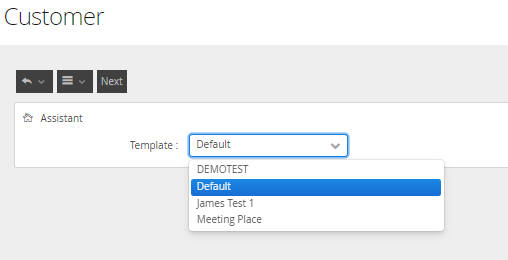
Once you have created your customer templates, when creating a customer manually within DRS, they will be selectable from a list and the relevant fields/options will be displayed.
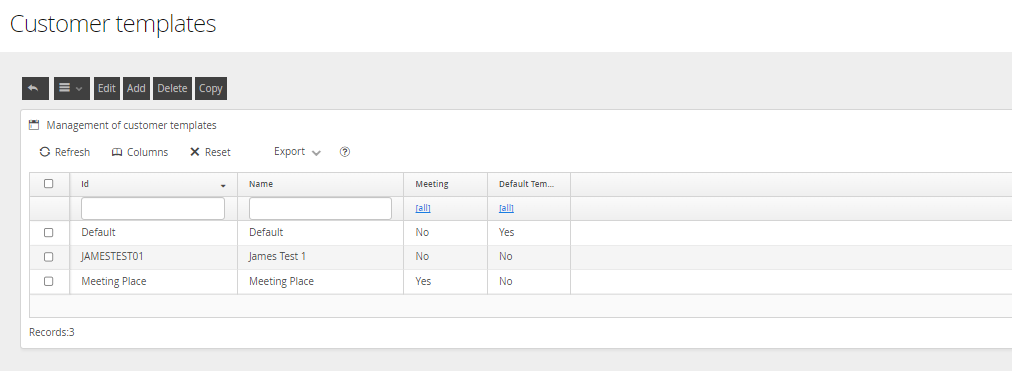
To add a Customer Template, click the Add button. Once Edits have been made click the Save button to save or the Cancel button to cancel changes.

Field Name | Description |
ID | This is a mandatory field and cannot be left blank and it requires a unique Id. |
Name | This is a mandatory field and cannot be left blank, it is the “friendly” display name of the template. |
Template for Meeting | this is used to distinguish if the location will be used as a meeting place and not used for regular customer locations. If it is not a meeting location do not check this box. |
Slots Template | This is optional but is used to determine the slot template which will apply to the created customers under this template. |
Default Template | This is to determine if this will be the default template to use when creating new customers. |
Calendar | This is optional but is used to specify which day off calendar will apply to the customer if required. |
Opening Hours | If checked this will display the following information: |
Configuring Opening Hours
Configuring Opening hours will impact the availability of any customer assigned to this Customer template.
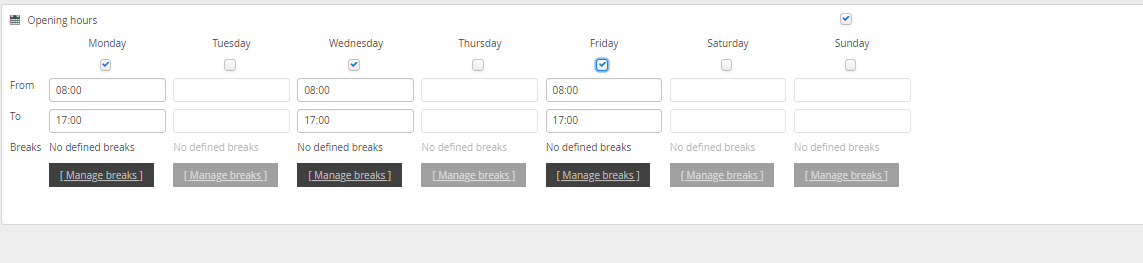
This will allow for opening hours for the customer to be defined. For example, if the template happened to apply to a chain of stores this could be used to determine the opening times of said stores, so DRS can plan in conjunction with the slots when somebody can attend.
Clicking Manage Breaks allows for breaks between these opening times to be applied when the customer will be unavailable.
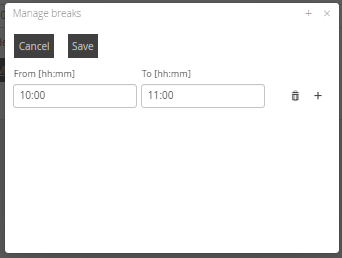
Once the above information has been completed Clicking the Save button will then allow Custom Object Attributes to be added to the template.

Configuring Custom Object Attributes
Custom Object Attributes are not mandatory, but they can be used to specify certain information which will be required by the system when creating a customer under this template.
Clicking the Add button will bring up the following window:
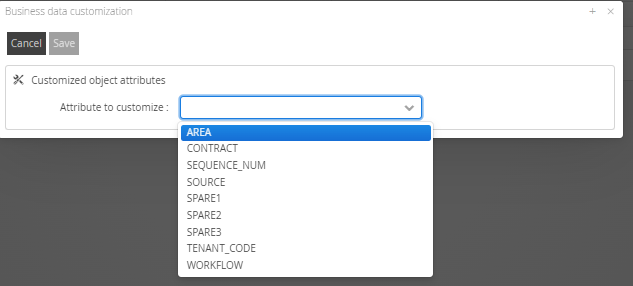
The information listed in this dropdown is populated from the Customers section within the Business Data.
When selecting the Attribute, a window will appear, the information required will depend on whether the Attribute is classed as a Closed List or not within Business Data. Below is an example of a Closed List:
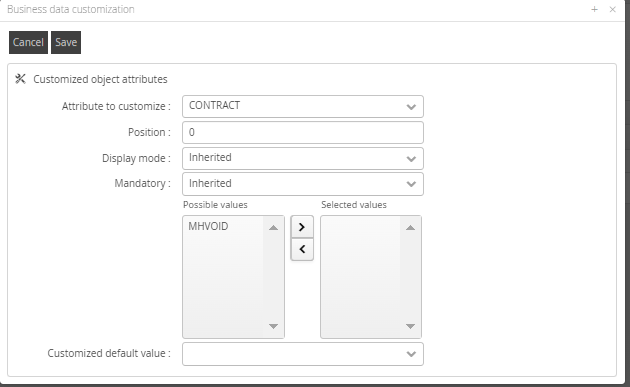
Field Name | Description |
Attribute to Customize | This is the attribute, which was selected initially, however this can be changed if required using the drop down. |
Position | This denotes the order position of the attribute when displayed |
Display Mode | Options include: Inherited – inherit the display mode from the Business Data display mode Hidden – Hide the attribute (usually used within conjunction with a default value – see below) Not modifiable – Can be seen but does not allow the value to be modified (usually used within conjunction with a default value – see below) Modifiable – Allows for the value to be changed |
Mandatory | Options Include: Inherited – inherit the Mandatory settings from the Business Data Mandatory settings Yes – The value must be populated before the customer can be created No – the value does not need to be populated if not required |
Possible Values | Note: Only visible if attribute is a closed list This list is populated from the values specified in the closed list within the Business Data section. |
Selected Values | Note: Only visible if attribute is a closed list These are the values which are selected from the Possible Values section to the left of it. Using the arrows will populate/unpopulated this list. |
Customized Default Value | Once the Selected Values section is populated this dropdown will be able to select a default value for the attribute from this list. If it is not a closed list, then this will be a free text option. |
Once Completed, clicking the Save button will add the Custom Object Attribute to the Customer Template
Once the Customer Template is completed, when adding a new customer, it will display in the Template dropdown to be selected as below: