Dynamic Resource Scheduler
Whats New!
User Experience Changes
Security and Authentication
Modules and Utilities
Cyclical Scheduling - Configuration Interface
Cyclical Scheduling - Now Bulk Scheduling
Resource Quotas Improvements - Percentages
Architecture and Scheduling
Configuration
User Guides and Help
Get to Know Dynamic Resource Scheduler
How Does Dynamic Resource Scheduling Work
Speaking the Language of Scheduling
Navigating Dynamic Resource Scheduler
How your Data Links Together
Managing your Organisation
Viewing your Data
Your Customer Data
Your Service Orders
Your Jobs
Your Workers and Resources
Manage Your Tasks
Actioning your Jobs and Tasks
Job Templates
Find A Jobs Possible Workers
Locking Your Jobs
Create a Follow On Task
User Queues and Organising Your Tasks
Schedule and Organise
How to Optimise Your Scheduling
How to Schedule Manually
Scheduling Mutliple Jobs at Once
Reassign and Reschedule your Tasks
Managing Your Time and Durations
Managing your Comments and Contacts
Using Bookmarks to Drive Efficiency
Managing Your Job Status
Visualising Your Planning
Workers and Resources
Advanced Data Management
Creating Unavailability in your Workforce
Adding an Unavailability to an Individual Worker
Creating Unavailabilities for Multiple Days or Workers
Maps And Journey
Using Maps to Visualise Your Data
Using Maps With Your Data
Learn about our Closest Function
Your Journeys
Meetings and Non-Productive Planning
Administer Your Scheduler
Managing Your Organisations and Agencies
Managing Your Custom Data
Managing your Contracts
Customising Your Experience
Managing Depots and Starting Locations
Managing Diary Bookmarks
Managing your External Chart Views
KPI Settings
Managing Your Priorities
Learn about Sectors
Managing Your Follow On Templates
Get To Know Your Working Time Calendar
Managing your SOR Templates
Managing your Job Templates
Managing Your Vocabulary
Managing Your Bookmarks
Manage Your Customer Templates
Get to Know Import and Export
Managing Your Tenant Code Rules
Managing your Order Templates
Managing Your Unavailability Reasons
Get To Know Your Working Time Calendars
Managing your Worker Templates
Releases and Readiness
DRS 6, DRS 5.7 and Job Manager
User Guides and Help
Get to Know DRS
Dynamic Scheduling - How does it work
Navigating DRS
Vocabulary and Concepts
Customers
Orders
Jobs
Scheduling Jobs
Job Functions
Workers
Views
Object Inheritance
Agencies
DRS Modules
Scenario Based Planning
Managing your SMS Service
5.7 Documentation
Technical Documentation
Release Notes
DRS 6.1 Release Notes
DRS 6.1.22 - February 20, 2026
DRS 6.1.21 - September 10, 2025
DRS 6.1.20 - April 20th, 2025
DRS 6.1.19 - 11th April, 2025
DRS 6.1.18 - 13 February 2025
DRS 6.1.17 - 20th December 2024
DRS 6.1.16 - November 8th, 2024
DRS 6.1.15 - October 10th, 2024
DRS 6.1.14 - 6th September 2024
DRS 6.1.13 - 9th August 2024
DRS 6.1.12 Release Notes
DRS 6.1.11 Release Notes
DRS 6.1.10 Release Notes
DRS 6.1.9 Release Notes
DRS 6.1.8 Release Notes
DRS 6.1.7 Release Notes
DRS 6.1.6 Release Notes
DRS 6.1.5 Release Notes
DRS 6.1.4 Release Notes
DRS 6.1.3 Release Notes
DRS 6.1.2 Release Notes
DRS 6.1.1 Release Notes
DRS 6.1.0 Release Notes
DRS 6.0 Release Notes
DRS 6.0.0.0 Release Notes
DRS 6.0.0.1 Release Notes
DRS 6.0.0.2 Release Notes
DRS 6.0.0.3 Release Notes
DRS 6.0.0.4 Release Notes
DRS 6.0.0.6 Release Notes
DRS 6.0.1.0 Release Notes
DRS 6.0.1.1 Release Notes
DRS 6.0.1.2 Release Notes
DRS 6.0.1.3 Release Notes
DRS 6.0.1.4 Release Notes
DRS 6.0.1.5 Release Notes
Kirona Housing
Job Manager 9
Job Manager 9.3.0 - October 2024
Job Manager 9.1.0 - December 2022
Job Manager 9.2.0 - November 2023
Release Notes Disclaimer
Administering your Field Service Products
Supported Versions Policies
Contents
- All categories
- Dynamic Resource Scheduler
- User Guides and Help
- Administer Your Scheduler
- Managing Your Organisations and Agencies
Managing Your Organisations and Agencies

An Agency represents your organisation within DRS and forms the foundation for how your data, resources, and operational structure are organised. It defines the ownership of key entities and controls how work is distributed across your service.
Within this structure, the following rules apply:
- A DRS system can support one or multiple Agencies
- Each Agency can contain multiple Contracts
- Properties can only belong to one Agency
- Workers can only belong to one Agency
- Sectors link Agencies and Workers together, defining where work can be carried out
Sectors play a key role in shaping your operational model, typically using postcode coverage to determine where work is assigned and how resources are deployed.
Because Agencies underpin the structure of your system, any changes should be approached with care. Updates to Sector and Agency relationships can impact linked Workers and may result in job disruption if not managed correctly. For this reason, Agencies are typically configured during initial system setup, and any changes should be discussed with an Advanced Consultant or Support before being applied.
Manage Your Agencies
Agencies are accessed through the Configuration option oni the left hand menu, by clicking on Agencies.
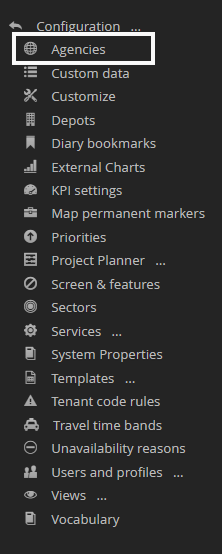
Selecting this option will display the currently configured agencies.
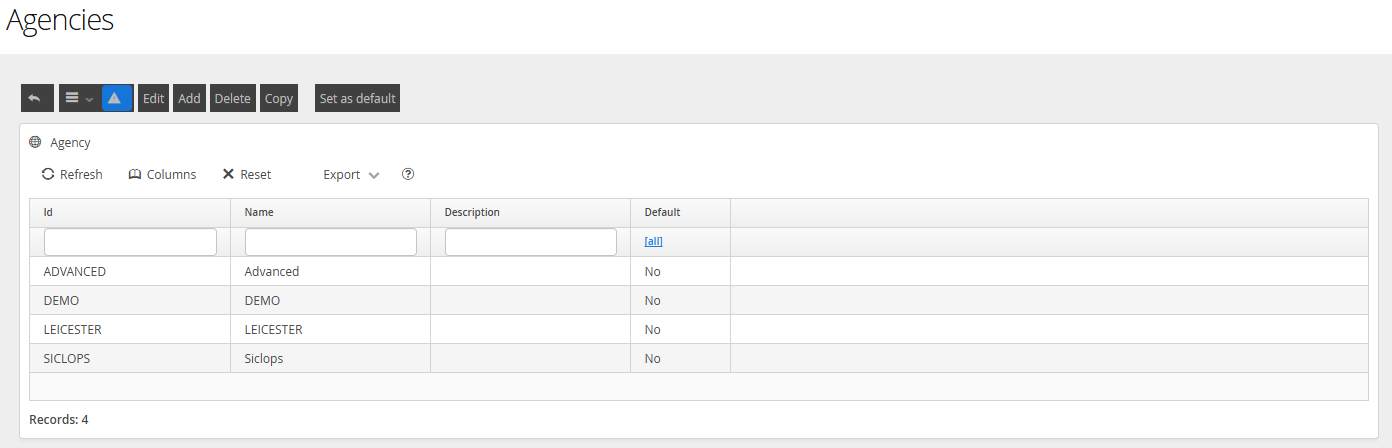
Via this window, you can Edit, Add, Delete or Copy an Agency.
To edit an Agency, select the Agency via the checkbox and click the Edit button. Once Edits have been made click the Save button to save or the Cancel button to cancel changes.
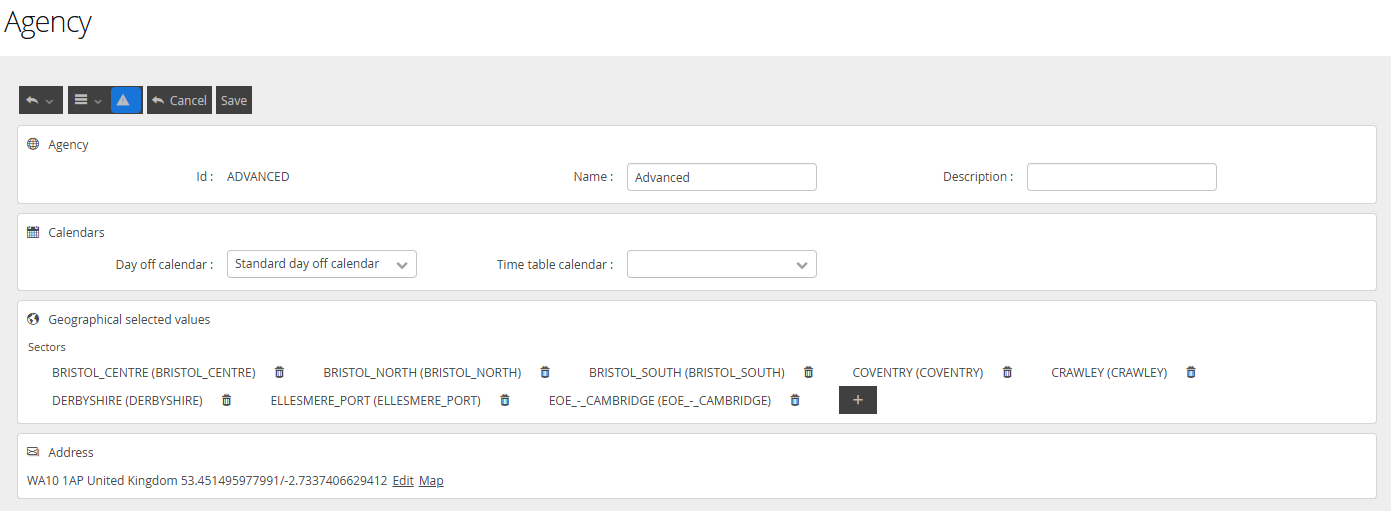
Under the Agency Header the following can be edited:
Field Name | Description |
Name | This is a mandatory field and cannot be left blank, this is the “friendly” display name of the Agency. |
Description | Here you can select the standard day off calendar which are default to the Agency. These are often allocated directly to the workers. |
Day Off Calendar | This will set the default Day Off Calendar used when creating Workers. |
Geographical Selected Values | You can configure which sectors the Agency has access to. |
Time Table Calendar | This will set the default Working Hours Calendar which will be used when creating Workers |
Address | This will set the default location for all Workers and Objects, if no location is provided. |
Updating Geographical Selected Values
When updating your Sectors, your experience will depend on how many sectors you have configured. Large volumes of sectors will result in a pick list.
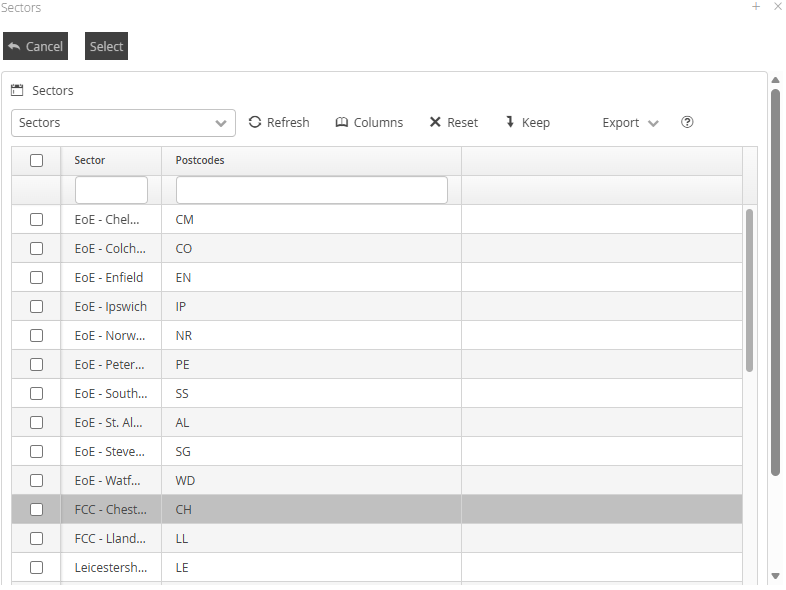
Checking a box and clicking Select will add the Sector to the Agency.
Updating Addresses
Under the Address header the address of the head office of the Agency is stored. You can edit this by clicking the Edit button.
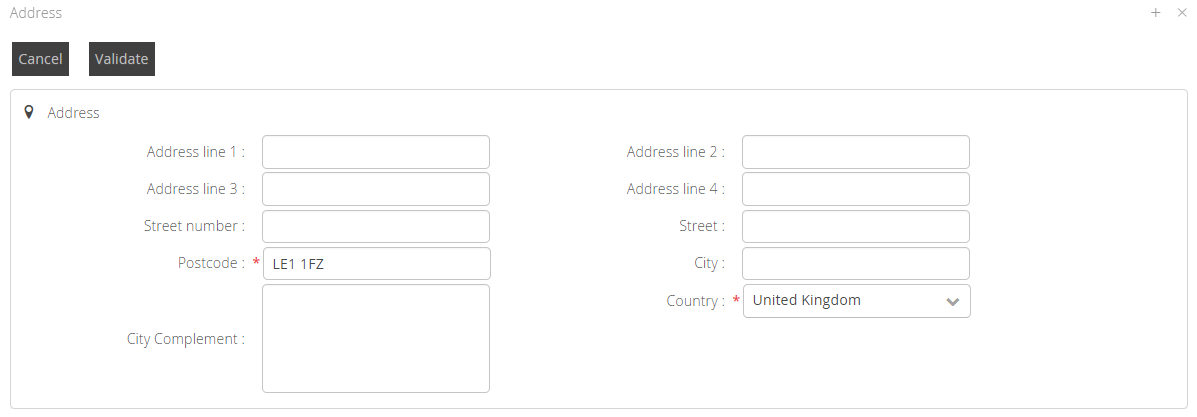
The address only requires the Postcode and Country fields to be completed because DRS utilises Postcodes in its scheduler logic. However, the rest of the address lines can be added also. To be saved the postcode and Country need to be valid and must be validated using the Validate button.
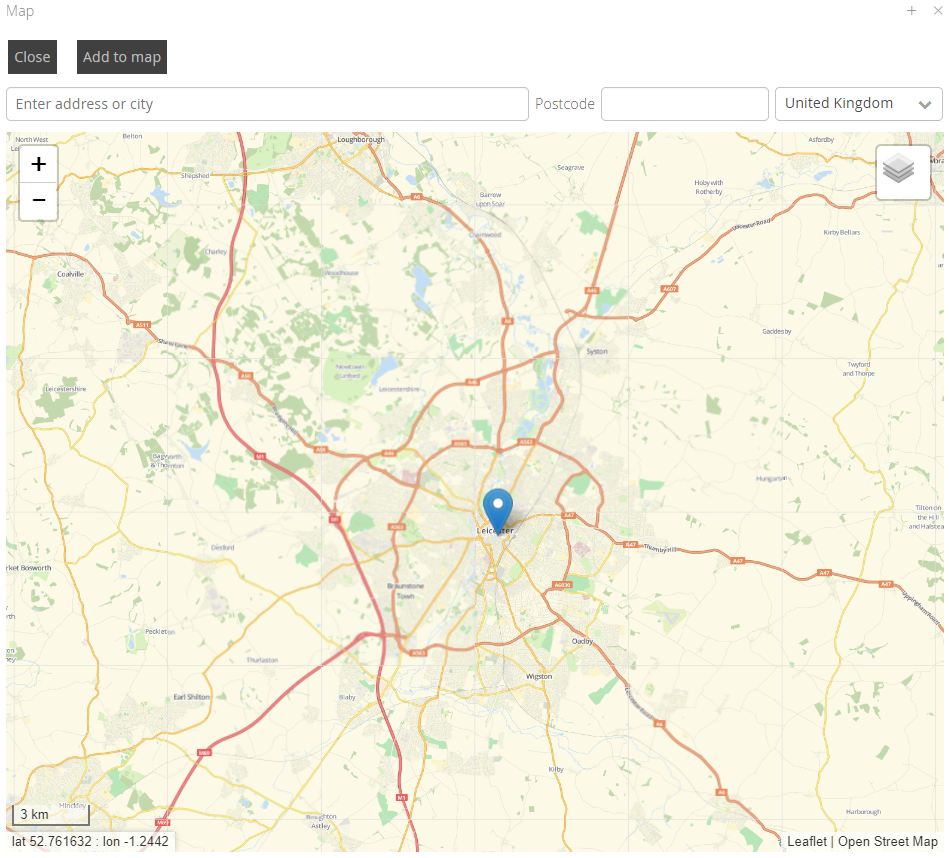
If you have the Maps module enabled, clicking the Map button will allow you to add and view the address on a map.