Dynamic Resource Scheduler
Whats New!
User Experience Changes
Security and Authentication
Modules and Utilities
Cyclical Scheduling - Configuration Interface
Cyclical Scheduling - Now Bulk Scheduling
Resource Quotas Improvements - Percentages
Architecture and Scheduling
Configuration
User Guides and Help
Get to Know Dynamic Resource Scheduler
How Does Dynamic Resource Scheduling Work
Speaking the Language of Scheduling
Navigating Dynamic Resource Scheduler
How your Data Links Together
Managing your Organisation
Viewing your Data
Your Customer Data
Your Service Orders
Your Jobs
Your Workers and Resources
Manage Your Tasks
Actioning your Jobs and Tasks
Job Templates
Find A Jobs Possible Workers
Locking Your Jobs
Create a Follow On Task
User Queues and Organising Your Tasks
Schedule and Organise
How to Optimise Your Scheduling
How to Schedule Manually
Scheduling Mutliple Jobs at Once
Reassign and Reschedule your Tasks
Managing Your Time and Durations
Managing your Comments and Contacts
Using Bookmarks to Drive Efficiency
Managing Your Job Status
Visualising Your Planning
Workers and Resources
Advanced Data Management
Creating Unavailability in your Workforce
Adding an Unavailability to an Individual Worker
Creating Unavailabilities for Multiple Days or Workers
Maps And Journey
Using Maps to Visualise Your Data
Using Maps With Your Data
Learn about our Closest Function
Your Journeys
Meetings and Non-Productive Planning
Administer Your Scheduler
Managing Your Organisations and Agencies
Managing Your Custom Data
Managing your Contracts
Customising Your Experience
Managing Depots and Starting Locations
Managing Diary Bookmarks
Managing your External Chart Views
KPI Settings
Managing Your Priorities
Learn about Sectors
Managing Your Follow On Templates
Get To Know Your Working Time Calendar
Managing your SOR Templates
Managing your Job Templates
Managing Your Vocabulary
Managing Your Bookmarks
Manage Your Customer Templates
Get to Know Import and Export
Managing Your Tenant Code Rules
Managing your Order Templates
Managing Your Unavailability Reasons
Get To Know Your Working Time Calendars
Managing your Worker Templates
Releases and Readiness
DRS 6, DRS 5.7 and Job Manager
User Guides and Help
Get to Know DRS
Dynamic Scheduling - How does it work
Navigating DRS
Vocabulary and Concepts
Customers
Orders
Jobs
Scheduling Jobs
Job Functions
Workers
Views
Object Inheritance
Agencies
DRS Modules
Scenario Based Planning
Managing your SMS Service
5.7 Documentation
Technical Documentation
Release Notes
DRS 6.1 Release Notes
DRS 6.1.22 - February 20, 2026
DRS 6.1.21 - September 10, 2025
DRS 6.1.20 - April 20th, 2025
DRS 6.1.19 - 11th April, 2025
DRS 6.1.18 - 13 February 2025
DRS 6.1.17 - 20th December 2024
DRS 6.1.16 - November 8th, 2024
DRS 6.1.15 - October 10th, 2024
DRS 6.1.14 - 6th September 2024
DRS 6.1.13 - 9th August 2024
DRS 6.1.12 Release Notes
DRS 6.1.11 Release Notes
DRS 6.1.10 Release Notes
DRS 6.1.9 Release Notes
DRS 6.1.8 Release Notes
DRS 6.1.7 Release Notes
DRS 6.1.6 Release Notes
DRS 6.1.5 Release Notes
DRS 6.1.4 Release Notes
DRS 6.1.3 Release Notes
DRS 6.1.2 Release Notes
DRS 6.1.1 Release Notes
DRS 6.1.0 Release Notes
DRS 6.0 Release Notes
DRS 6.0.0.0 Release Notes
DRS 6.0.0.1 Release Notes
DRS 6.0.0.2 Release Notes
DRS 6.0.0.3 Release Notes
DRS 6.0.0.4 Release Notes
DRS 6.0.0.6 Release Notes
DRS 6.0.1.0 Release Notes
DRS 6.0.1.1 Release Notes
DRS 6.0.1.2 Release Notes
DRS 6.0.1.3 Release Notes
DRS 6.0.1.4 Release Notes
DRS 6.0.1.5 Release Notes
Kirona Housing
Job Manager 9
Job Manager 9.3.0 - October 2024
Job Manager 9.1.0 - December 2022
Job Manager 9.2.0 - November 2023
Release Notes Disclaimer
Administering your Field Service Products
Supported Versions Policies
Contents
- All categories
- Dynamic Resource Scheduler
- User Guides and Help
- Administer Your Scheduler
- Get To Know Your Working Time Calendars
Get To Know Your Working Time Calendars

Working Time configuration is used to define when workers are available for scheduling, when they are unavailable, and how their working patterns should be applied within DRS.
Configuring your Working Time Calendars
There are a number of options within this area, that you can choose to configure
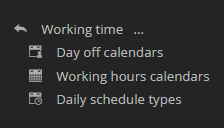
Configuration Area | Purpose |
Day Off Calendars | Define dates where work cannot be scheduled, such as public holidays or company holidays |
Working Hours Calendars | Define regular or cyclical working hours for workers |
Daily Schedule Types | Define reusable day patterns used within Roster Calendars |
Day Off Calendars
Day Off Calendars are used to create a list of dates where work cannot be scheduled into a worker’s diary.
They are commonly used for national holidays, company holidays, or other planned non-working days.
A Standard Day Off Calendar is typically created to hold common dates that apply to multiple workers. Separate Day Off Calendars can also be created where different workers require different non-working dates.
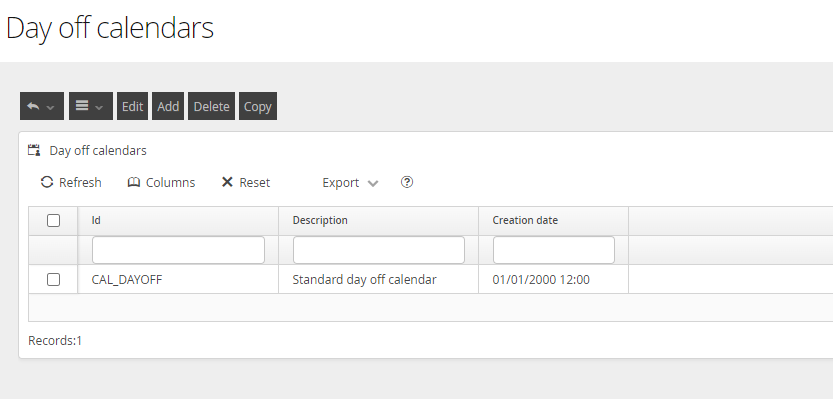
When adding or editing a ‘day off’, a start and end date is specified along with a relevant comment and/or unavailability reason which will be displayed in the diaries the calendar is associated with.
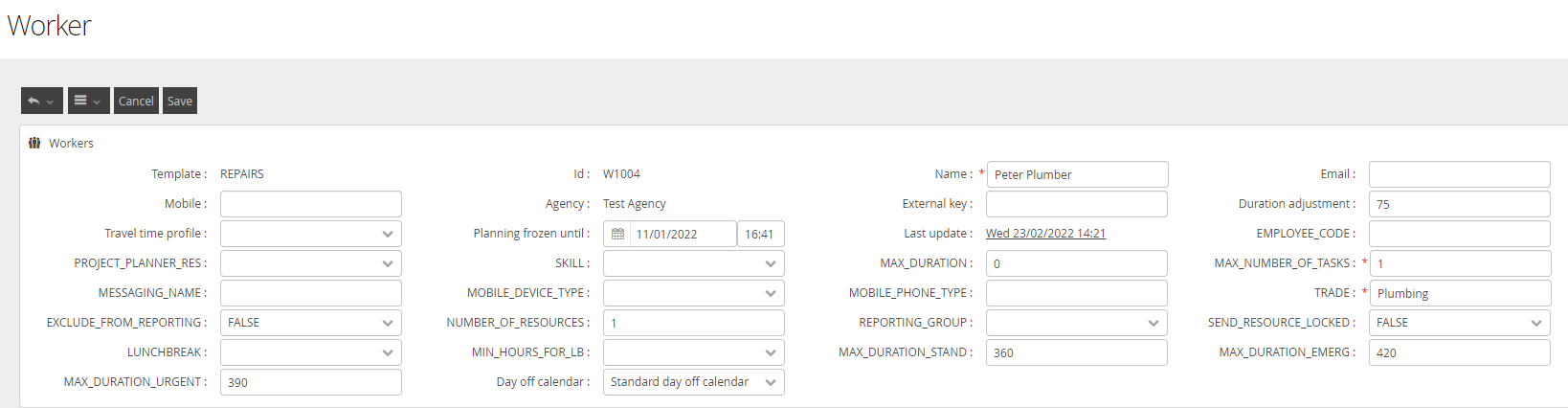
Below shows where the day off calendar can be selected within a worker record on the bottom row
Working Hours Calendars
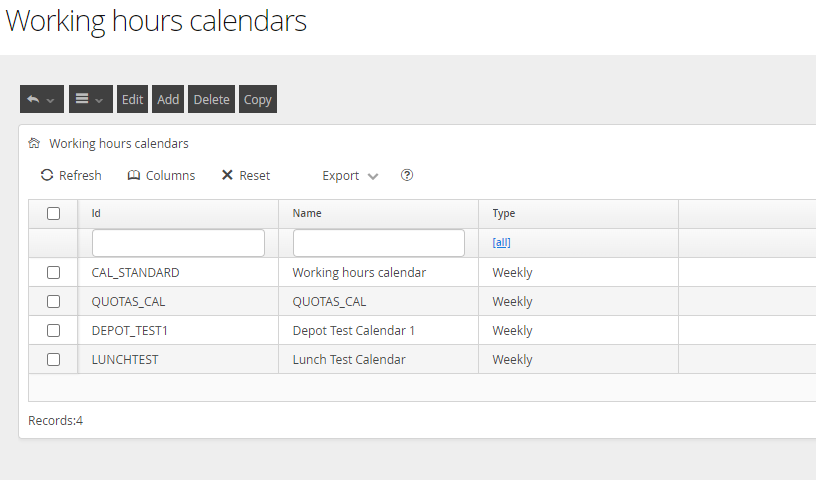
Working Hours Calendars define when workers are available for scheduling.
Calendars are linked to Worker records and are used by the scheduling calculation to determine worker availability.
There are two types of Working Hours Calendar:
Calendar Type | Description |
Weekly | Used for regular weekly working patterns |
Roster | Used for cyclical working patterns or shifts |
Both calendar types allow a fixed lunch break to be applied. However, fixed lunch breaks are not always recommended, as some jobs, such as all-day jobs, will not be automatically split around these breaks.
Working Hours Calendars can be managed using the buttons at the top of the page.
Action | Description |
Add | Create a new Working Hours Calendar |
Edit | Amend an existing calendar |
Copy | Copy an existing calendar and amend it as required |
Delete | Remove a calendar that is no longer required |
When creating new calendars, you are presented with the following screen where you can populate the name, specify the type, include Quotas (discussed in the Quotas section below) and populate a timetable of the hours that will be worked.
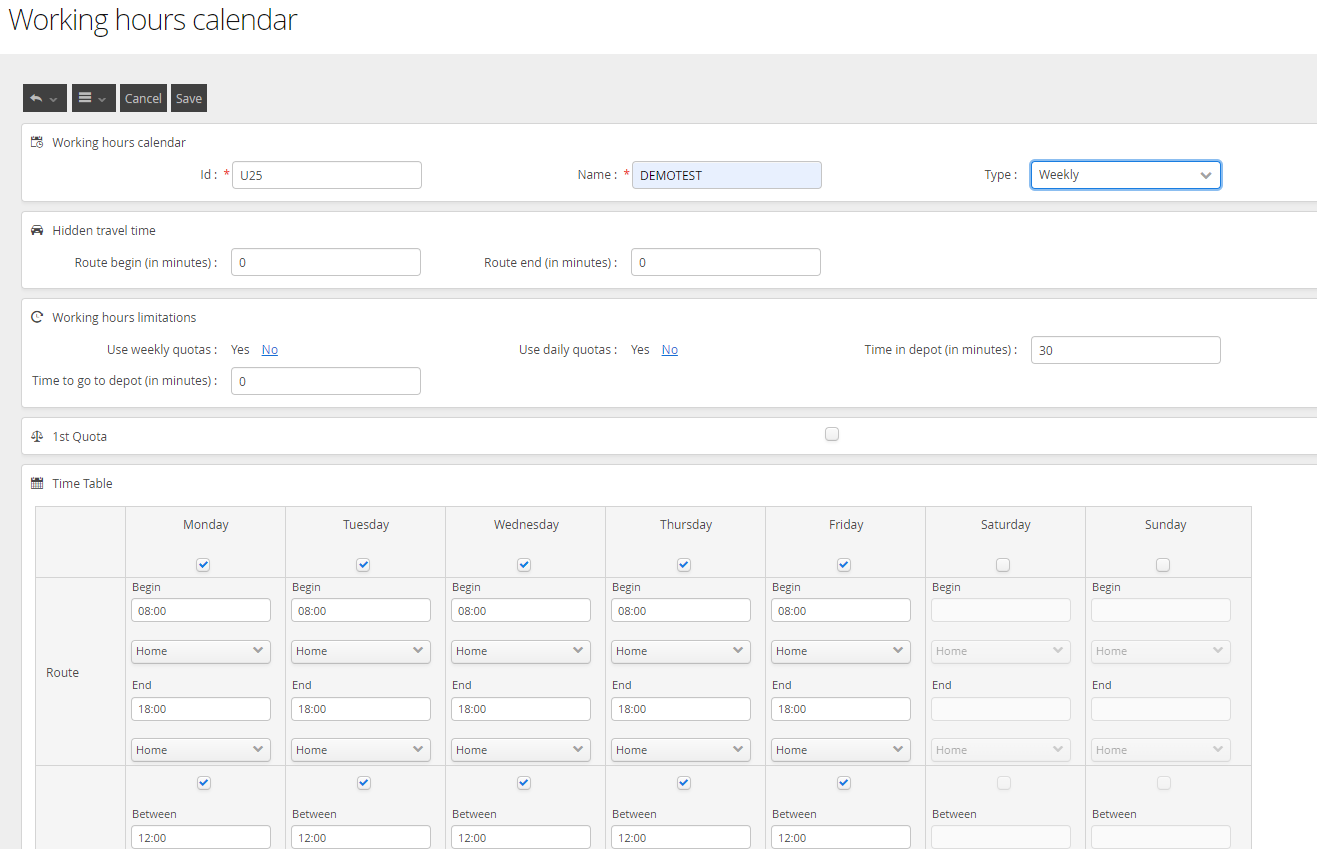
Hidden travel time allows you to factor in minutes at the start and end of each day that only account for travel. We have a lot of customers using this to prevent the unnecessary travel at the start and end of each day coming into the diary and impacting on the working day. It ensures that if an operative has up to 30 minutes of travel in the morning for example that he arrives on site for 8am where travel doesn’t exceed this value. If travel was 45 minutes, then only 15 minutes of the travel time would come into the diary/working day.

Working Hours Limitations allow you to introduce weekly/daily quota limitations surrounding time spent at a Depot. For more information on configuring this please contact your Advanced Consultant

Weekly Calendars
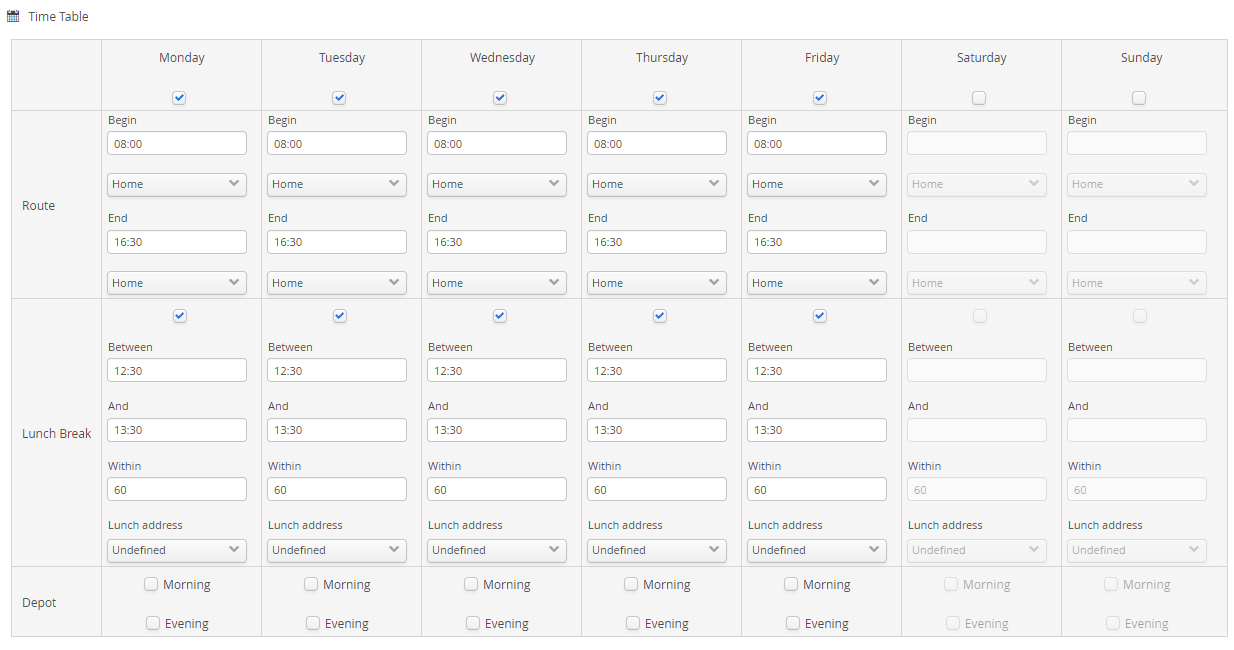
Weekly Calendars are used for workers who follow a regular weekly working pattern, rather than a cyclical shift or roster pattern.
They allow you to define which days are working days and which days are non-working days.
For each day, you can configure:
Field Name | Description |
Working Day | Select the checkbox to confirm the worker is available on that day |
Begin Time | The start time of the worker’s working day |
End Time | The end time of the worker’s working day |
Lunch Break | Optional fixed lunch break period |
Fixed lunch breaks can be added to Weekly Calendars. However, this is not always recommended, as some jobs, such as all-day jobs, will not be automatically split around these breaks.
Weekly Calendars also allow you to define where the worker starts and ends their working day.
Start and end locations can be set as:
Location | Description |
Home | The worker starts or ends from their home location |
Agency | The worker starts or ends from their assigned agency location |
Hotel | The worker starts or ends from a hotel location |
You can also specify whether the worker starts or ends the day at a depot, where this applies.
Roster Calendars
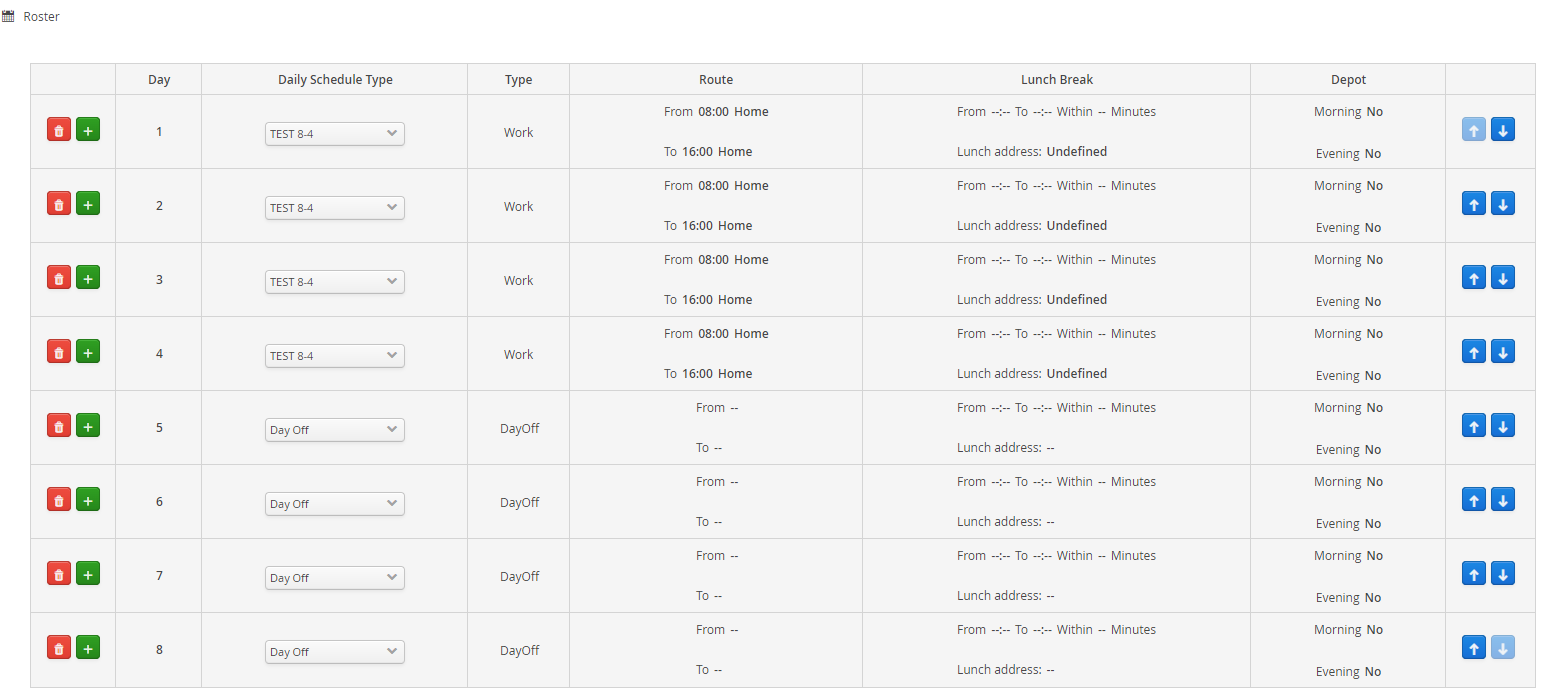
Roster Calendars are used for workers who follow a cyclical working pattern or shift-based arrangement. They are typically linked to a start date, which is used to determine where the worker is within the repeating pattern. A Roster Calendar defines both working and non-working days, including the start and end times for each working day.
For example, a 4 on, 4 off roster would allow a worker to work for 4 days, followed by 4 days off, before the pattern repeats.
Roster Calendar timetables use a slightly different format to Weekly Calendars.
Instead of configuring each day of the week, you build the repeating pattern by adding or deleting days within the roster timetable. Each day in the pattern is assigned a predefined Daily Schedule Type. These Daily Schedule Types define the working times and day type used for that part of the roster.
Once the roster pattern has been created, DRS uses the start date and timetable sequence to calculate the worker’s availability.
Quotas
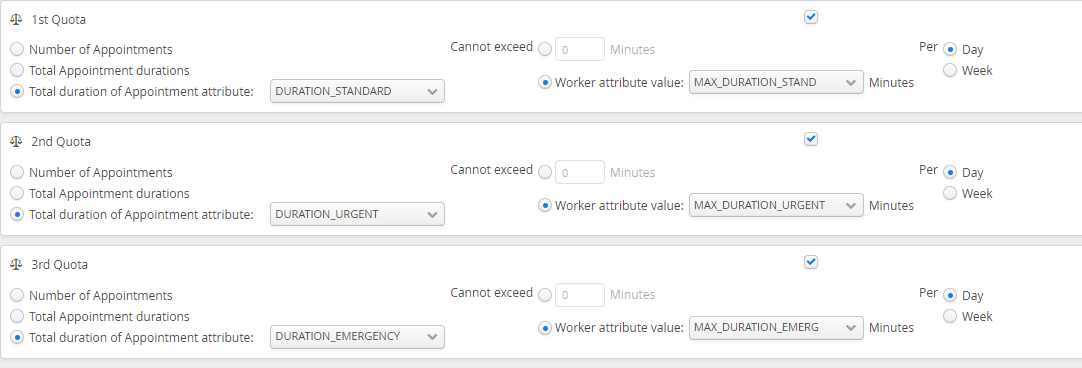
Quotas are used to reserve diary capacity for specific priorities of work.
They are commonly used to hold capacity for emergency work that may be raised on the current day. This helps prevent worker diaries from being filled entirely with lower priority work, such as urgent or standard jobs.
By reserving capacity for emergency work, jobs can be booked at the first point of customer contact instead of being passed to a planner to manually fit into already full diaries.
Quotas are configured using a standard Working Hours Calendar. Duration Fill levels are set (in minutes) against configured Emergency, Urgent and Routine Jobs using configured Attributes.
The priorities are matched against the Priority Type configured in your PRIORITY menu.
You can set Quotas to calculate Weekly or Daily. Daily is the recommended configuration for Quotas.
Quotas require configuration and consultancy from an Advanced Consultant. Please consult your Advanced Consultant for more information on this.
Daily Schedule Types
Daily Schedule Types are used to build Roster Calendars.
Before creating a Roster Calendar, you must first create the Daily Schedule Types that will be used within the roster timetable.
Daily Schedule Types define the timings and type of day that can be selected when building the roster pattern. For example, they may be used to define a standard working day, a late shift, a weekend shift, or a non-working day.
From the Daily Schedule Types page, you can create new schedule types or delete existing ones.
Action | Description |
Add | Create a new Daily Schedule Type |
Delete | Remove a Daily Schedule Type that is no longer required |
Edit | Update an existing Daily Schedule Type |
Copy | Copy the configuration of a schedule type. |
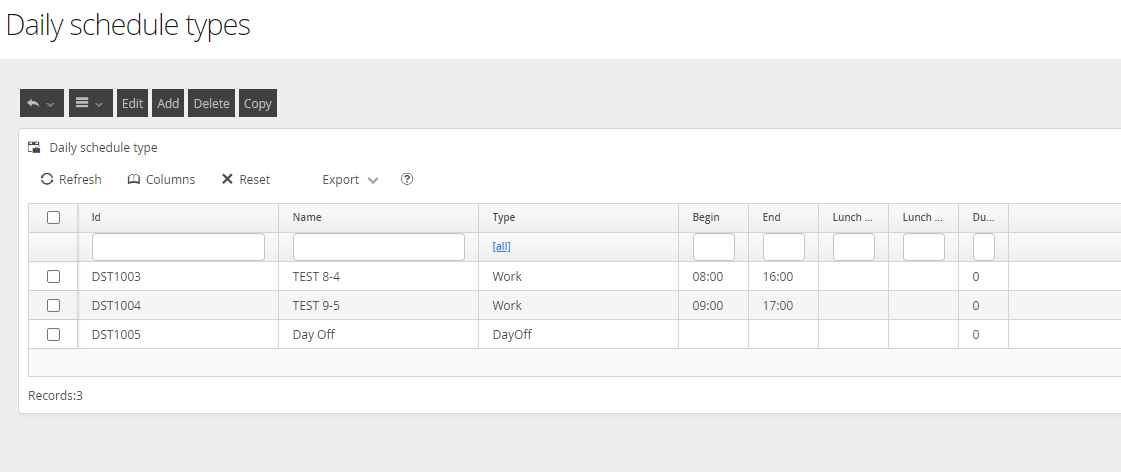
When creating/editing a new type, you can
When creating or editing a Daily Schedule Type, you can define:
Field Name | Description |
ID | The unique identifier for the Daily Schedule Type |
Name | The display name for the day type |
Begin Time | The start time for the day |
End Time | The end time for the day |
Day Type | Defines the type of day, such as working or non-working |
Lunch Breaks | Determines whether lunch breaks apply |
Depot Use | Determines whether depot configuration applies |
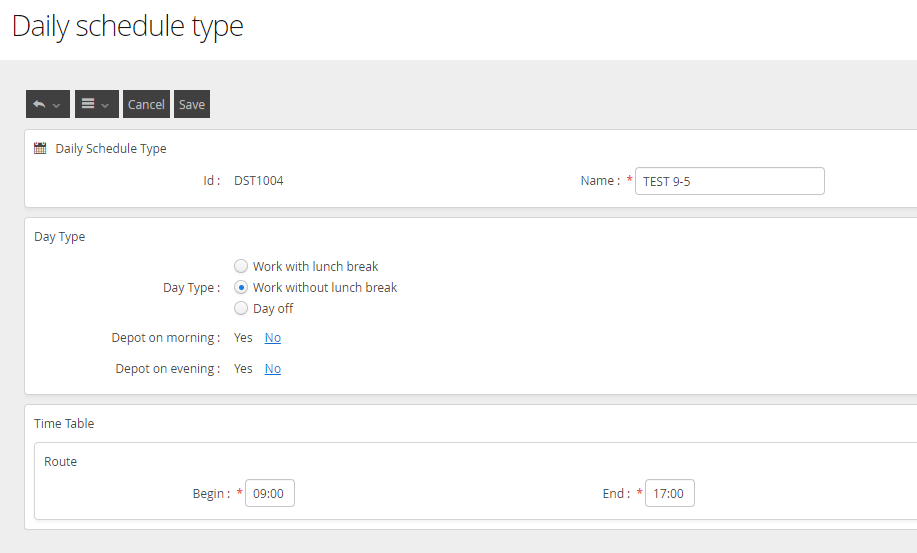
Once created, Daily Schedule Types can be selected when building the timetable for a Roster Calendar.